

Flexible Noise Silencers

When a standard rigid pipe won't fit, a flexible silencer becomes an indispensable solution. It not only dampens noise but also acts as a flexible connector, compensating for installation misalignments.
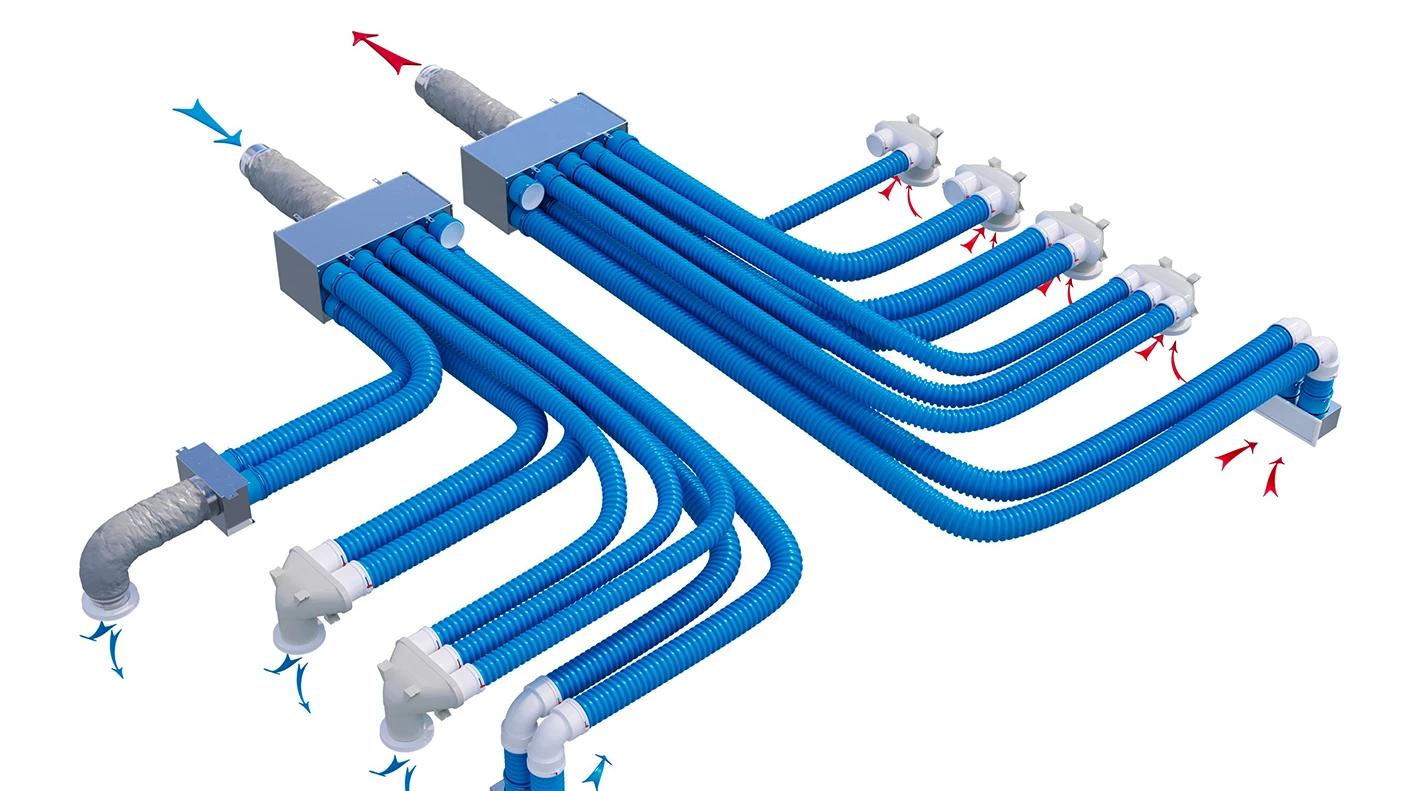
The ideal choice for connecting a manifold to a ventilation unit or diffuser boxes in tight ceiling voids.
AKU-COMP A Lankstus Izoliuotas Triukšmo Slopintuvas€40.91-€127.30
AKU-COMP Lankstus Izoliuotas Triukšmo Slopintuvas€37.75-€94.83
Silent ventilation without complex installation
The problem: vibrations and lack of space
Rigid ducts are great for airflow, but they are also great at transmitting sound. Every vibration from the fan travels through the metal pipe straight into your rooms. Additionally, when installing ventilation in low ceiling voids, there is often not enough space to align rigid elbows perfectly.
Installation errors turn into noise. Trying to force-fit slightly misaligned rigid ducts creates tension, which later turns into resonating sound. Flexibility here is not just a convenience, but a necessity.
The solution: a flexible acoustic barrier
A flexible silencer acts as the system's shock absorber. It physically separates the ventilation unit from the ductwork, preventing vibrations from traveling further. The mineral wool filling effectively absorbs aerodynamic noise, while the flexible construction allows you to easily bypass beams or other obstacles.
This is a renovator's best friend. When you need to connect a new heat recovery unit to old ducts or when a diffuser location shifts slightly, a flexible silencer solves the problem without complex rework.
Double benefit: a flexible silencer not only dampens sound but also compensates for installation inaccuracies, acting as a vibration-absorbing connector.
How to choose a flexible silencer?
Choose based on connection diameter and desired silence level. While all silencers perform the same function, their design differs based on application:
- Length (0.6 m vs 1.2 m) – in acoustics, length is everything. A 1.2 m silencer will always perform better than a 0.6 m one. If you have the space, always choose the longer option, especially for main runs.
- Insulation thickness (25 mm vs 50 mm) – 25 mm is the standard suitable for most residential systems. 50 mm insulation is "heavy artillery" – choose it if your unit is powerful or located near sleeping areas.
- Connection type – most flexible silencers fit directly onto a duct or fitting. Check if your manifold outlets match the silencer diameter.
When to choose flexible over rigid?
The flexible model is indispensable at terminal points. Use it for the connection between the main pipe and the manifold box, or between the duct and the diffuser box. Leave rigid silencers for long straight runs where rigidity and low resistance are key.
Installation and maintenance details
Correct installation
Improperly installed silencers can work against you. Compressed insulation loses its properties, and excessive bending creates resistance to airflow.
- Stretch fully – before forming a bend, stretch the silencer completely. This ensures a smooth inner surface and minimal air resistance.
- Avoid sharp angles – form gentle, large-radius curves. Sharp creases inside cause turbulence, which generates noise itself.
- Fastening – use metal clamps for a tight seal. Since the silencer is soft, it is important not to overtighten and deform the inner pipe.
Longevity
Flexible silencers last the entire lifetime of the system. They do not need cleaning or replacement unless physically damaged. The most important thing during installation is not to damage the outer jacket so that moisture does not enter the insulation. A correctly installed flexible silencer is a one-time investment in a quiet home.


