Flexible vs. Steel Ducts: The Definitive Guide for A++ Homes
Deciding between flexible plastic and rigid steel ducting? Discover why radial flexible systems dominate modern builds and when galvanized steel is still the right choice.
ORO Haus team
You’ve chosen your recuperator—that’s a great start. Now you face the most critical engineering decision: how will that air reach your rooms? The ducting is the "circulatory system" of your home, hidden behind drywall or concrete for decades. A mistake here is costly: lost ceiling height, audible conversations between rooms, or a failed airtightness test.
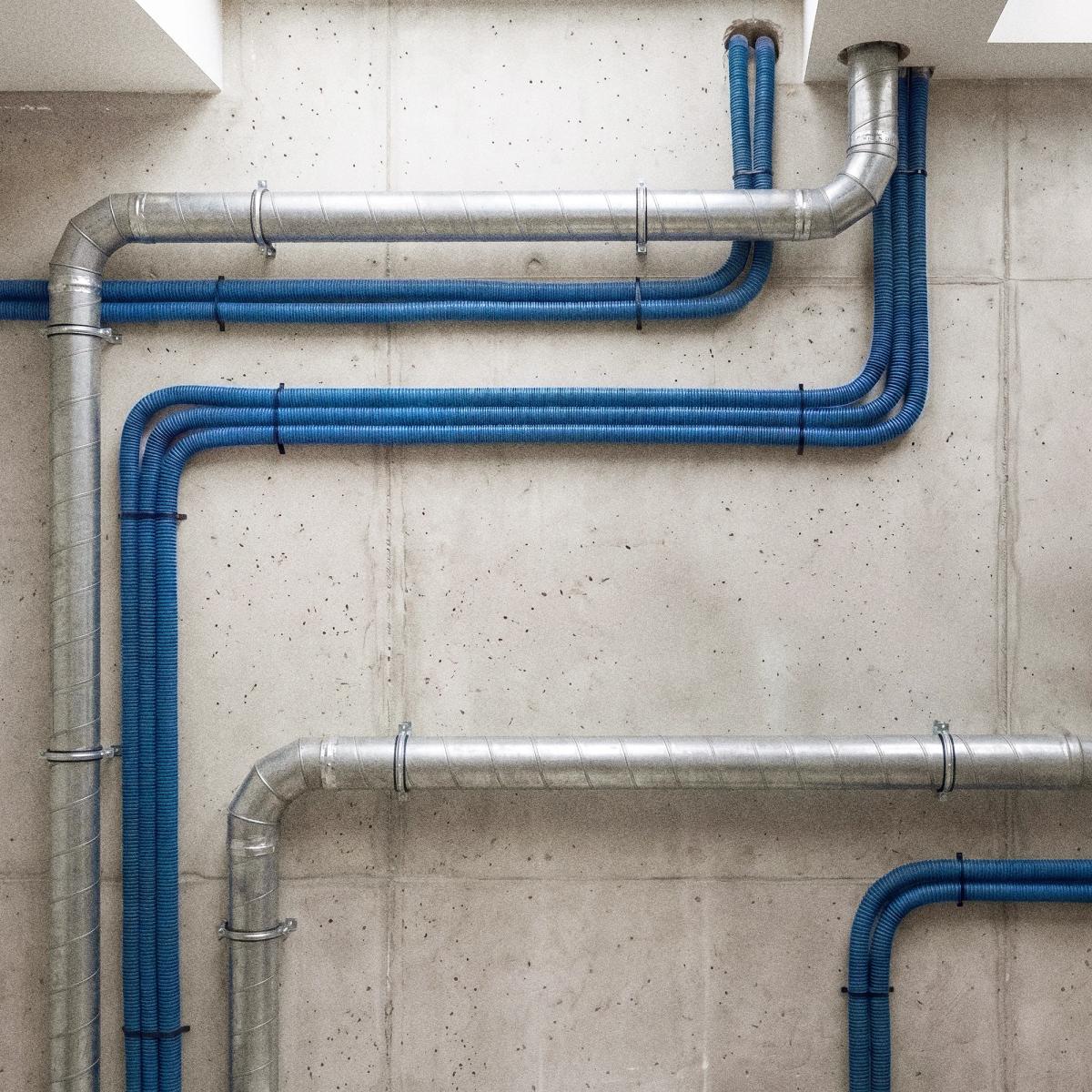
The Baltic market is dominated by two systems: traditional galvanized steel (trunk-and-branch) and modern flexible radial (manifold system). In this guide, we objectively compare them based on technical specs, installation speed, and their impact on your daily comfort.
- Space Saving: Flexible systems (75/90 mm) only require 10–12 cm of ceiling void.
- Acoustics: The radial layout naturally eliminates "crosstalk" (sound doesn't travel between rooms).
- Airtightness: Factory seals ensure the airtightness required for A++ certification without messy mastics.
- Cost: While the pipes are more expensive, installation is 3x faster, often making the total project cheaper.
1. Technical Duel: Numbers Don't Lie
Engineering-wise, both systems have their place, but their operating principles differ fundamentally. Galvanized steel offers the lowest air resistance, while flexible plastic provides superior hygiene and acoustic insulation.
| Parameter | Flexible System (PE/PP) | Galvanized Steel (Spiro) |
|---|---|---|
| Typical Diameter | 75 mm / 90 mm | 100 - 200+ mm |
| Ceiling Void Required | 10 - 12 cm | 20 - 30 cm |
| Connection Type | Mechanical (O-ring) | Rivets, screws, mastic |
| Crosstalk Noise | None (Radial) | High (Requires silencers) |
| Inner Coating | Antistatic, Antibacterial | Smooth Zinc |
| Fire Class | D-s2, d2 (Combustible) | A1 (Non-combustible) |
Important: When discussing flexible ducts, we refer to ==semi-rigid PE/PP pipes== (e.g., 75 mm), not the cheap foil "flex" hoses, which should never be used in professional ventilation systems.
2. Acoustics and Privacy: Why Radial Wins?
A galvanized steel system works like a "ship's telephone": all rooms are connected to one main trunk. If children are playing in one room, the sound travels easily through the metal pipe to your bedroom. This is known as "crosstalk" noise.
Flexible systems use a radial principle: every diffuser has its own dedicated pipe leading back to a sound-absorbing manifold. The sound has to travel 10–15 meters to the manifold, dissipate there, and travel another 10–15 meters to reach the next room. Therefore, a flexible system ensures maximum privacy without extra investment in bulky silencers.
3. Installation and A++ Blower Door Tests
In modern construction, the Blower Door test is mandatory. In a galvanized steel system, there are hundreds of joints that the installer must manually seal with mastic and foil tape. One missed spot in a dark attic—and your house fails certification.
Flexible systems use factory rubber O-rings and locking clips. You hear a "click"—and the connection is 100% airtight. This eliminates human error and allows for a 1-day installation instead of a 3-4 day struggle with sheet metal.
Climate Context: If ducts run through an unheated attic, galvanized pipes must be insulated with thick rockwool (min. 50-100 mm) to prevent condensation. Flexible ducts are easier to handle, but insulation is mandatory for both systems in cold zones.
4. Cost: The Bottom Line
Most homeowners only compare the price per meter, where steel wins. However, let's look at the total budget for a 120 m² home:
| Cost Category | Flexible System | Galvanized Steel |
|---|---|---|
| Materials (Pipes, fittings, manifolds) | 1100 – 1400 € | 800 – 1200 € |
| Installation Labor (1 day vs 4 days) | 400 – 600 € | 1200 – 1800 € |
| **Total** | **1500 – 2000 €** | **2000 – 3000 €** |
Conclusion: While flexible plastic materials are more expensive upfront, the labor savings make this solution more economical for the finished project.
5. When Should You Still Choose Galvanized Steel?
Despite the dominance of flexible pipes in residential homes, galvanized steel remains the standard in these scenarios:
- Large Projects (>250 m²): When moving massive air volumes over long distances.
- Industrial Design: When ducts are left exposed (loft style) as a design feature.
- Main Trunk Lines: Even in flexible systems, the line from the recuperator to the manifold is usually rigid galvanized (or pre-insulated EPP) pipe.
Decision Framework
Choose flexible ducts if: you are building a standard home up to 200 m², want to maximize ceiling height, plan to DIY, or prioritize whisper-quiet privacy between rooms.
Questions about your project? Send us your floor plans, and we will prepare a precise quote for your ducting and unit.
👉 Shop our categories: Flexible Duct Systems | Galvanized Steel Ducts